
If you are looking into learning to sail, you have probably come across three sets of initials that keep appearing: RYA, ASA, and IYT. All three are legitimate certification systems, all three will teach you how to handle a boat, and all three can lead to bareboat charter privileges. But they are not interchangeable, and the differences between them matter — especially when it comes to where your certification is recognized, how charter companies treat your credentials, and what the course experience actually looks like.
This guide breaks down the key differences between RYA, ASA, and IYT: where each certification comes from, where it is most recognized, how the course structures compare, and what kind of sailor each system is best suited for.
The Three Major Certification Bodies
Before diving into comparisons, it helps to understand what each organization actually is and where it comes from.
RYA (Royal Yachting Association) is a UK-based organization that has been governing sailing education since 1875. It is the national body for sailing in the UK and sets training standards that are recognized across Europe, the Mediterranean, and much of the former Commonwealth. If you have ever heard someone talk about doing their "Day Skipper" or "Yachtmaster," they are almost certainly referring to RYA qualifications.
ASA (American Sailing Association) was founded in 1983 and is the dominant certification system in the United States. It operates through a network of affiliated sailing schools across the US, Caribbean, and parts of Central America. The ASA system is structured around numbered courses (ASA 101, 103, 104, and so on), which makes progression straightforward to understand.
IYT (International Yacht Training) is a Canadian-founded organization established in 2000 that operates globally. IYT certifications are recognized in over 30 countries and are particularly common in Southeast Asia, the Caribbean, and parts of Central America. IYT positions itself as a truly international alternative, and its certificates are often accepted where neither RYA nor ASA has strong footing.
Where Each Certification Is Most Recognized
This is the most important practical difference between the three systems. The certification you hold determines how smoothly things go when you try to charter a boat in a specific region.
RYA is the gold standard in Europe and the Mediterranean. If you plan to bareboat in Greece, Croatia, Turkey, Spain, or anywhere else in the Med, RYA credentials are the most universally accepted. Charter companies in these regions often specifically ask for RYA Day Skipper or above. RYA is also widely recognized in the UK (obviously), Australia, New Zealand, South Africa, and much of Southeast Asia. Many Mediterranean countries also accept an ICC (International Certificate of Competence), which RYA schools can issue to students who complete the Day Skipper course. You can browse sailing schools in Greece or Croatia on SailingTree — almost all of them teach the RYA curriculum.
ASA dominates in the United States and the Caribbean. Nearly every sailing school in Florida, the BVI, and the USVI operates on the ASA system. American charter companies like The Moorings, Sunsail (in the US market), and Dream Yacht Charter accept ASA certification. If your sailing ambitions are centered on the US, the Caribbean, and possibly Central America, ASA is the practical choice.
IYT fills in the gaps. Its international recognition makes it popular in regions where neither RYA nor ASA has established deep roots — places like Thailand, parts of the Caribbean, Central America, and some Mediterranean locations. IYT certificates are accepted by many of the major charter companies worldwide, and the organization has worked to build broad recognition. Schools like Island Spirit Sailing School in Thailand run IYT programs that attract students from all over the world.
| Certification | Strongest Regions | Charter Acceptance |
|---|---|---|
| RYA | UK, Mediterranean, Australia, NZ, South Africa | Widely accepted globally, especially in Europe |
| ASA | United States, Caribbean, Central America | Strong in the Americas; less common in Europe |
| IYT | Southeast Asia, Caribbean, global reach | Accepted by most major charter companies worldwide |

How the Course Structures Differ
Each system uses its own course progression, but they roughly align at key milestones. Here is how the beginner-to-bareboat pathway works in each.
RYA Pathway
The RYA system starts with Competent Crew, a five-day live-aboard course that teaches the fundamentals of crewing on a yacht. From there, Day Skipper (also five days practical, plus a separate theory component) is the key milestone — it qualifies you to skipper a yacht in familiar waters during daylight hours. This is the level most charter companies require. Beyond that, Coastal Skipper and Yachtmaster Offshore extend your range to coastal and offshore passages.
RYA courses tend to have a strong theory component. Day Skipper theory covers chartwork, tidal calculations, meteorology, and collision regulations. You can do the theory portion online or in a classroom before the practical course. This is particularly useful if you want to be well prepared before your week on the water.
ASA Pathway
ASA uses numbered courses. ASA 101 (Basic Keelboat) is the starting point, covering the fundamentals of sailing a small to mid-size boat. ASA 103 (Basic Coastal Cruising) adds navigation and living aboard. ASA 104 (Bareboat Cruising) is the bareboat chartering qualification — once you have this, you can charter independently with most American and Caribbean companies. Many schools bundle ASA 101 + 103 or ASA 103 + 104 into week-long combo courses, which is a popular and cost-effective approach.
ASA courses integrate theory and practical time together during the course itself. There is no separate theory exam to pass beforehand, though each course does include a written test and practical assessment. For students who prefer to learn everything in one concentrated block, this format works well.
IYT Pathway
IYT's structure sits somewhere between RYA and ASA. The International Crew course (five days) is the entry point, followed by International Bareboat Skipper, which qualifies you for independent chartering. IYT also offers Yachtmaster Coastal and Yachtmaster Offshore certifications for those who want to go further. Some schools offer a "Zero to Hero" fast-track that combines Crew and Bareboat Skipper into roughly ten days.
IYT courses typically run as live-aboard programs with theory woven into the practical training. The curriculum is designed to be internationally relevant, so it covers seamanship principles that apply regardless of where you sail. This global focus is one of IYT's main selling points.
| Level | RYA | ASA | IYT |
|---|---|---|---|
| Complete beginner | Competent Crew | ASA 101 | International Crew |
| Independent day sailing | Day Skipper | ASA 103 + 104 | International Bareboat Skipper |
| Coastal passages | Coastal Skipper | ASA 105 + 106 | Yachtmaster Coastal |
| Offshore / professional | Yachtmaster Offshore | ASA 108 | Yachtmaster Offshore |
What Each Certification Is Best Suited For
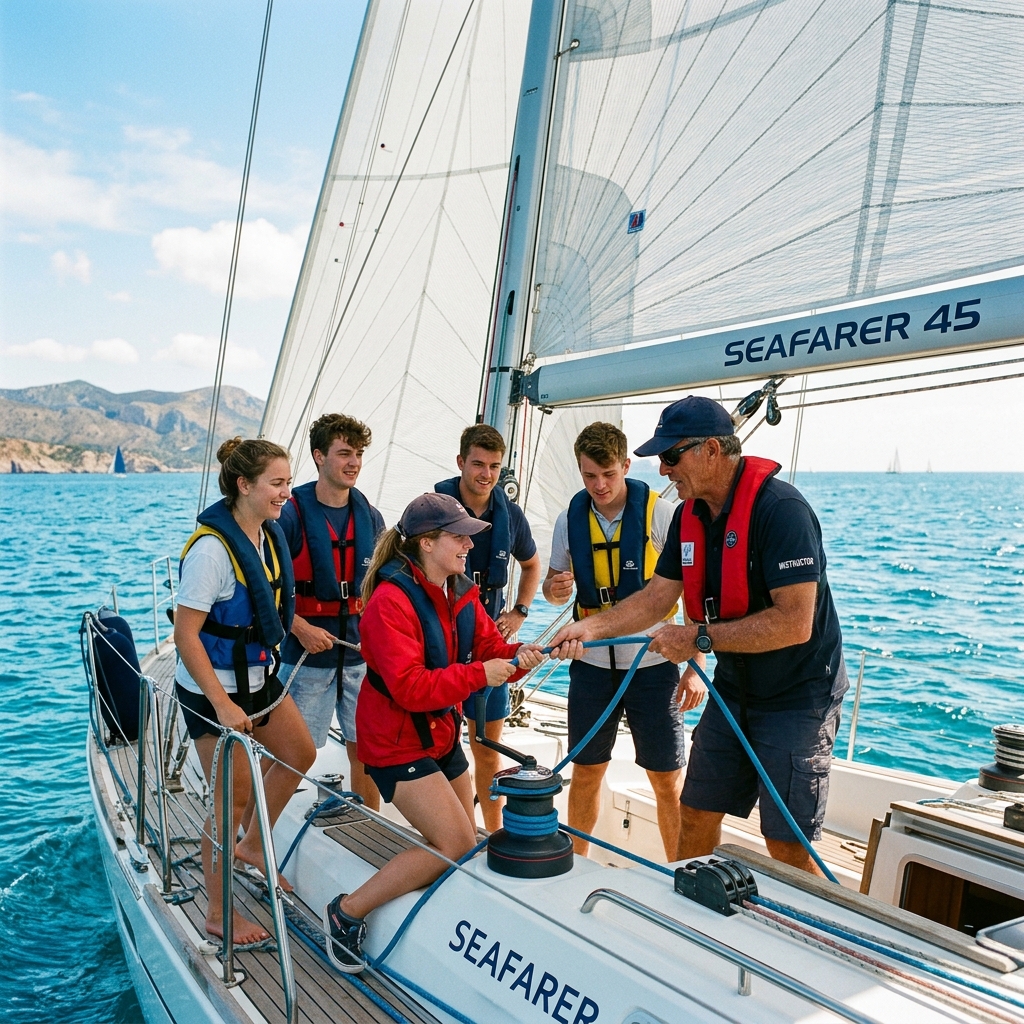
The differences between these systems matter most when you consider what you actually want to do on the water. Here is how the three certifications line up against the most common goals.
Bareboat chartering in the Mediterranean
RYA is the strongest option here. Mediterranean charter companies overwhelmingly prefer RYA Day Skipper, and many countries in southern Europe require an ICC for foreign skippers — which RYA schools can issue. If your goal is to charter in the Greek islands, the Croatian coast, or the Turkish Riviera, RYA is the path of least resistance. Check out Mediterranean sailing schools on SailingTree to find RYA-accredited options.
Chartering in the US or Caribbean
ASA is what charter companies in these regions expect. If your plans center on the BVI, USVI, Florida, or the Bahamas, ASA is the standard credential. The course progression is straightforward, schools are plentiful (especially in Florida and the Caribbean), and you will have no issues presenting ASA 104 at any American charter base.
Sailing across multiple regions
IYT offers the broadest international recognition. If you are not sure where you will sail or if you plan to move between regions — say, learning in Thailand and then chartering in the Caribbean — IYT's global reach is a practical advantage. It is also worth considering if you are based in a country where neither RYA nor ASA has a strong presence. Schools like those in Thailand often offer IYT courses that are well-suited to international students.
Just learning to sail for the experience
If chartering is not on your immediate radar and you simply want to learn how to sail — to understand the wind, handle a boat confidently, and enjoy time on the water — then the certification system matters less than the quality of the school and the location. Pick the destination that excites you, find a well-reviewed school there, and take whatever system they offer. You will learn the same core skills regardless. All three systems teach you how to sail; the differences are mainly about credentials and recognition.
Cost and Duration
Costs vary significantly by location rather than by certification system. A five-day course in Greece might cost £800–£1,200, the same course in Florida might run $1,000–$1,800, and in Thailand it could be $1,200–$1,500. The certification system itself does not dictate the price — local costs of living, boat quality, and instructor ratios are the main drivers.
Duration is fairly consistent across all three systems. Entry-level courses run about five days. The bareboat qualification (Day Skipper / ASA 104 / International Bareboat Skipper) also runs about five days, though some schools offer week-long combo packages that cover both levels. If you can set aside two weeks, you can go from complete beginner to bareboat-qualified in any of the three systems.
Can You Convert Between Systems?
There is no formal conversion process between RYA, ASA, and IYT. If you hold an ASA 104 and want to charter in Greece, you may find that some companies accept it, but others will specifically ask for RYA Day Skipper or an ICC. In practice, many experienced sailors hold certifications from more than one system, having taken courses in different locations over the years.
The good news is that skills transfer completely. If you already hold an ASA qualification and want to get RYA-certified, a good school will recognize your existing ability and you will likely move through the course faster, even if you still need to complete all the practical assessments.
Finding the Right School
Once you know which certification system fits your goals, the next step is finding a school. SailingTree's sailing schools directory lets you filter by certification type and location, read reviews from past students, and compare course offerings side by side. Whether you are looking for an RYA school in the Mediterranean, an ASA school in the Caribbean, or an IYT program in Southeast Asia, the directory is a good starting point for narrowing down your options.
The most important thing is to start. Whichever system you choose, you will come away with real skills, real confidence, and a certification that opens the door to chartering your own boat. The rest is details.